While environmental regulations have ensured that the particulate matter load due to the use of motor vehicles has fallen continuously, this anthropogenic source is, since the Covid-19 and energy crises, now being overtaken by the release of particulate matter from private wood-fired installations (heating systems and wood-burning stoves). Particulate matter is not only potentially harmful to health but also impairs the quality and functioning of sensitive products in many fields in the optics, electronics, electromechanical, medical engineering, biotechnology and pharmaceuticals sectors. Among the various technical approaches to cleaning indoor air, filter techniques have proven to be particularly valuable because they represent an economical alternative offering low operating costs and can also be retrofitted to existing equipment The only way to prevent suspended particles and particulate matter is to clean the indoor air correctly!
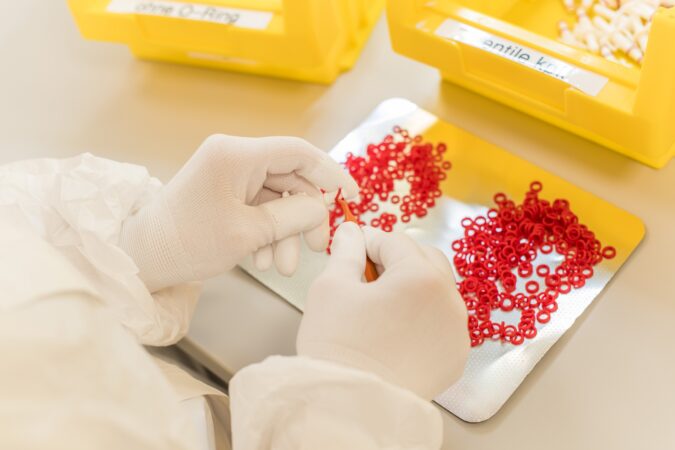
As an example of a successfully implemented clean-room solution, we would like to present the company “Alternative Produktion”, or AL-PRO Gerd Böhm GmbH for short. This company can look back on a history of more than 20 years that have been characterized by sustainable growth, continuous further development and the desire to find the ideal solution for each of its customers. As an industrial service provider, it now employs a more than 50-strong team in two plants in Göttingen, 12 of whom have been trained and instructed in clean-room operations. As a service provider, AL-PRO offers electromechanical assembly services (main area of activity) as well as cable assembly and product picking and finishing activities. For the last five years, it has also undertaken manufacturing, assembly, cleaning and packaging under clean-room conditions. Its customers come from the optics, microelectronics and electromechanical fields as well as from the chip assembly sector, for which electrostatically protected areas are available.
In three independent clean-room systems occupying an area of 200 m², AL-PRO manufactures products subject to particularly stringent requirements in terms of the permissible manufacturing environment. The clean rooms are TÜV-certified to class 7 or 8 in accordance with ISO 14644-1 and are customer-certified to GMP class D. Thanks to the presence of a laminar flow box, the air quality can be increased to clean-room class 5 as per ISO 14644-1 when required. The hygiene concept was developed in the light of the practical implementation of the GMP guidelines and includes not only particle monitoring but also external monitoring of the microbiological load as well as external pest monitoring. In this way, environmental loads such as airborne microbes and dust or aerosol particles can be kept to an absolute minimum, thus meeting an essential prerequisite for applications in the biotechnology, medical technology and pharmaceutical sectors.
The clean rooms were planned by Spetec GmbH and retrofitted in the existing factory halls, an operation which required only minimal structural changes to the building. The clean-room environments are configured in a very flexible way to meet changing requirements.
Wherever particles, particulate matter or germs might alter products and their quality, we need to take measures to protect products. Mobile, small units, such as laminar flow boxes, are always advisable if the individual production steps require little space. If the customer’s requirements grow, an entire production line can be set up using a combination of cleanroom modules. If a large amount of space is required or if the boxes need to be accessible because more complex production or packaging is necessary, then a cleanroom or cleanroom cell is an ideal solution. An existing cleanroom can be retrofitted at any time using the modular system. This protects the customer from expensive bad investments and is particularly sustainable because existing components can be integrated into a new concept.
The company Spetec is the right partner here and offers customized solutions wherever particles, fine dust or germs can change product properties or impair product quality.