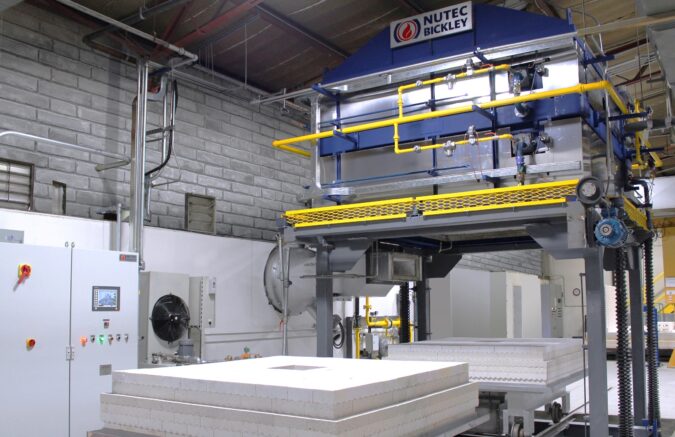
Nutec Bickley has designed and manufactured a custom elevator kiln for one of North America’s longest established technical ceramics producers. The design features a stationary refractory-lined steel bell, with the entire kiln mounted on heavy-duty support legs. The loaded kiln car containing the product is raised and lowered to and from the kiln.
Advantages over a conventional shuttle kiln include eliminating the complexities of a high-temperature door and providing a better containment system for the lining refractories. The customer will also benefit from low maintenance and long life, alongside only needing a relatively small footprint on the production floor compared to conventional kilns.

Alberto Cantú, Nutec Bickley’s VP Ceramics, commented: “This customer is a trusted supplier of rigorously tested and proven lines to advanced manufacturing sectors such as foundry, PM, MIM, and technical ceramics, and as such must rely on the best available technologies and fabrication quality when it comes to specifying new kilns. Its choice of Nutec Bickley is further endorsement of our wide-ranging capabilities in the technical ceramics sector.”
The new gas-fired kiln will typically run on an 80-hour cycle, with an operating temperature of 1,705 °C (3,100 °F) and a maximum temperature of 1,720 °C (3,130 °F). The single car is 1.22 m (4 ft) long and provides for a total setting volume of 1.72 m3 (60.75 ft3).
Firing tangential to the load are four high-velocity nozzle-mix burners, the highest standard industrial models that guarantee low NOx emissions and stable high excess air and excess fuel operation, while featuring direct spark ignition, integral air and gas meters, and flame rod ionization. Firing in lanes along the length of the kiln, these burners provide excellent turbulence and heat transfer, while their position in the kiln promotes optimum temperature distribution and uniformity throughout the load.
This elevator kiln operates with mass flow combustion control, a system that relies on extremely accurate flow sensors for both the air and fuel supplies to each control zone/burner. Flow and temperature are monitored continuously, and this information is fed to the PLC which then modulates the gas and air to each temperature control zone accordingly. This method provides full and flexible control over each control zone.
Fuel-to-air ratios can be programmed via the PLC and used to vary the gas/air ratios throughout the various cycle segments. This method eliminates the use of proportional regulators, impulse piping and other setups, thus greatly simplifying the operation of the kiln. All data is recorded on the SCADA system to facilitate smooth troubleshooting and quality control procedures.
The kiln’s exhaust system is a natural updraft type with air curtain control. The pressure inside the kiln is sensed by a pressure transmitter and the signal is connected to the control system. The pressure control loop modulates the output to the air curtain control which in turn varies the exhaust flow controlling the kiln pressure. An overpressure alarm system initiates an audible and visual alarm in the event of a high-pressure condition in the kiln.
Also vital in delivering optimum conditions for firing technical ceramics are the highest performing insulation materials and effective and durable fixing. Heat resistant alloy metal anchors are attached to the casing to provide the Nutec Bickley ‘floating anchor’ system. This system anchors the refractory to the steel wall in a way that allows expansion and contraction movement of the refractory wall parallel to the steel casing, keeping the refractories from moving away from the shell for longer service life.
The kiln is fully lined using a high thermal efficiency sandwich construction of refractory and insulation materials. Backup is block and firebrick, while the hot face is 230 mm-thick (9 in) bubble alumina rated to 1,815 °C (3,300 °F). Low maintenance, suitably sized expansion joints are used throughout the kiln. All the joints are packed with high-temperature ceramic fibre.
The kiln’s elevation system sees the car raised into firing position using a heavy-duty screw-jack lifting mechanism for smooth operation. A positive alignment pin secures the car to the lifting base. For each cycle, the kiln car is manually rolled onto the platform under the kiln, and the platform is then raised. A limit switch that indicates the car has been lifted to the full raised position permits the start of the combustion sequence. When the firing cycle is completed, the car is lowered. The lift motor starter is interlocked with the control system to prevent the car from being accidentally lowered when the kiln is still dangerously hot.