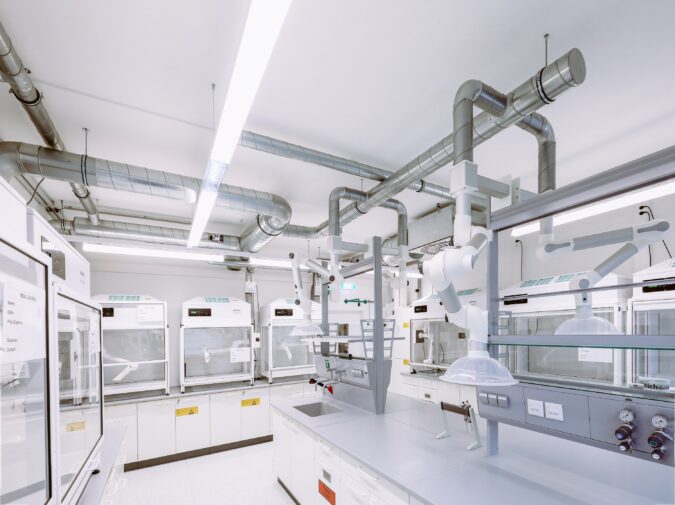
Inductively coupled plasma mass spectrometry (ICP-MS) is now so sensitive that it can be used for measurements in the ultra-trace range below one ppt (parts per trillion, ng/kg or pg/g). However, analytical laboratories must be appropriately designed if they are to be able to make use of the investigative capabilities of this method, because a single particle from the ambient air can contaminate the sample and render the results unusable. An example provided by the Chair of “General and Analytical Chemistry” (AAC) at the Technical University of Leoben (MUL) in Austria shows how easily particles can be avoided (https://aach.unileoben.ac.at). The MUL adopts a circular engineering perspective to lifecycle-oriented systems and materials research and is known as Austria’s “raw materials university”.
Following Professor Prohaska’s appointment to the University’s Chair of General and Analytical Chemistry, a general renovation of the MUL’s chemistry building was required, one reason being that it was necessary to create clean room conditions allowing to operate a certain number of ICP-MS devices. To create the desired clean room conditions, the University installed a range of equipment, including eight laminar flow boxes manufactured by Spetec GmbH, with the result that clean room class ISO 5 was achieved within the building. The most precise of the installed analytical devices is a high-resolution ICP-MS with a multicollector-detector design. This makes it possible to determine the concentration of an element in the ppt range and identify its isotope composition with extreme accuracy. The AAC is currently examining 7000-year-old artifacts from an archaeological dig in Asparn in Lower Austria. To do this, it measures the presence of strontium isotopes (87Sr/86Sr) in teeth and bones and comparing the measured values with environmental concentrations. Because bone finds suggest war and conflict, the question is where the intruders came from and what trade relations were already established at that time. To find an answer, it is necessary to examine tiny samples (minuscule drill holes in teeth) trying to measure differences in isotope ratios in the ppm range. When doing so, all contamination must be avoided to prevent the elimination of traces dating back thousands of years.
Spetec GmbH has many decades of experience not only in atomic spectroscopy but also in the development and use of clean room and air purification systems for analytical chemistry, meaning that it had the expertise necessary to achieve the required level of purity in the laboratory premises quickly and economically.
(Photo: Copyright Montanuniversität Leoben)