Membranes and engineered nonwoven filter media have had a significant influence on water filtration and the major manufacturers of both technologies –as well as all associated suppliers of processing equipment– will be well represented at the FILTECH 2026 exhibition and conference taking place in Cologne, Germany, from June 30th to July 2nd.
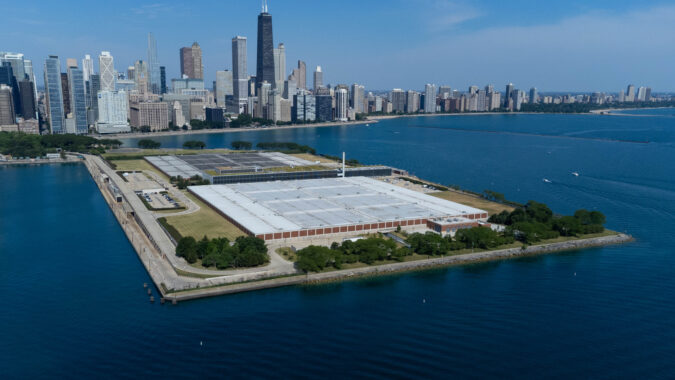
To illustrate the influence of fibre and polymer media, it’s worth considering how the world’s largest water filtration plant – the Jardine water purification plant in Chicago, which entered service in the mid-1960s – might be designed and constructed today.
Scale and permanence
The Jardine plant (shown in the main picture, © Sea Cow) represents how advanced societies thought about water security at the time, in an era shaped by post-war reconstruction, rapid urban growth and a deep faith in civil engineering as a guarantor of public health. If a city needed more or cleaner water, the answer was scale and permanence. Jardine was conceived as infrastructure that would outlast generations, and to date it has.
Using large-scale filtration and disinfection to turn raw water from Lake Michigan into potable water for millions of people, the plant purifies around 1.4 billion US gallons (over 5 million m3) a day.
Lake Michigan provided an abundant and relatively stable surface water source, but was still subject to seasonal variability, storm events and the cumulative impacts of industrialisation and urban runoff. Treatment philosophy at the time favoured processes that were well understood, tolerant of fluctuation and inherently conservative. Coagulation and flocculation converted fine, unpredictable raw water solids into something visible and manageable. Vast sedimentation basins allowed gravity the time to do its work and rapid gravity sand filters then provided a final, physical barrier operators could trust.
Symbol of reliability
Sand, in this context, was not just a filter medium, but a symbol of reliability. A sand bed is heavy, passive and forgiving and does not rely on delicate materials, tight tolerances or complex control systems. If raw water quality deteriorated, operators could slow filtration rates, increase chemical doses and accept shorter run times. The system absorbed variability through mass and volume which made perfect sense in an era when land was readily available, energy was cheap and digital monitoring did not exist.
New considerations
Jardine therefore belongs to a lineage of plants designed to manage uncertainty by building it into the structure itself.
This philosophy has proved remarkably durable, yet the world that produced Jardine is not the world in which new water infrastructure is now conceived. Urban land is constrained and energy and carbon carry explicit costs. Raw water variability is no longer just seasonal but increasingly driven by climate dynamics and at the same time, expectations around water quality have tightened, not only in regulatory terms but in public perception.
In addition, continued urbanisation, industrial discharge and agricultural runoff have introduced a more complex mix of contaminants, including microplastics, heavy metals, pharmaceuticals and persistent organic compounds.
Modern treatment plants are consequently being asked to deliver higher consistency from more complex sources, often within tighter spatial and operational envelopes and filter media has become increasingly more sophisticated in response.
Defined barriers
Membrane filtration represents a shift from probable to defined barriers.
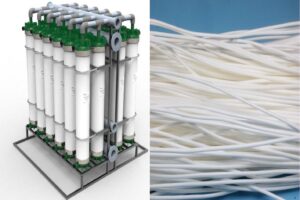
Where a sand filter relies on a combination of depth, particle capture and operator judgement, a membrane provides a nominal pore size and an integrity concept that can be tested and verified. Ultrafiltration (UF), microfiltration (MF) and reverse osmosis (RO) membranes bring a level of precision that was simply unavailable when Jardine was designed. They also invert the spatial logic of mid-century plants – instead of spreading processes horizontally across acres of civil works, membranes concentrate treatment capacity into compact, modular units.
Structural backbone
Nonwoven filter media plays a more subtle but equally important role. In membrane systems, nonwoven layers form the structural backbone of many modules, supporting thin active membrane layers and distributing flow. Their performance is largely invisible to the end user, yet without them modern membrane technology would not exist in its current form.
In parallel, nonwovens have also evolved into stand-alone filtration media that replace granular beds with engineered fabrics.
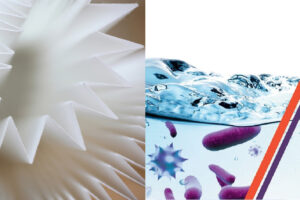
What distinguishes them is not simply material choice but controllability. A sand bed is a statistical system and its pore structure emerges from grain size distribution, packing and operational history.
With nonwoven media, by contrast, fibre diameter, orientation, density and thickness are specified to achieve particular hydraulic and capture characteristics. Cleaning mechanisms can be integrated directly into the fabric structure, allowing filtration and cleaning to be decoupled in ways that are difficult with mineral beds.
Managing uncertainty
In the design of a modern equivalent of Jardine today, these technologies would not simply be used as replacements for sand, but actively shape how uncertainty is managed.
Rather than relying on volume and depth to buffer raw water variability, a contemporary design would focus on conditioning the water so that downstream barriers see a narrow, predictable range of conditions. High-rate clarification, improved monitoring and tighter process control would aim to present filtration systems with a consistently manageable load.
Within such a framework, nonwoven filters would be a logical evolution of the rapid gravity filter concept. They would perform a similar role, acting as a physical solids barrier downstream of clarification, but with a much higher surface area per unit and faster recovery after cleaning. Their use would reduce the need for large backwash water volumes and allow filtration capacity to be added or removed incrementally rather than in monolithic blocks.
In a plant of Jardine’s scale, membranes would be most valuable as selective barriers, deployed to manage peak events, degraded raw water conditions or particularly sensitive distribution demands. They would provide precision where it is most needed, without forcing the entire plant to operate under the energy and operational regime of full-flow membrane treatment.
Seen in this light, the modern plant would not abandon the conservatism of its mid-century predecessor, but reinterpret it. Efficiency would no longer rely on dozens of identical sand filters but from multiple, complementary barriers that respond differently to stress. Reliability no longer depends on sheer physical mass but on material engineering and control. The aim remains the same as it was in the 1960s – to deliver safe drinking water continuously, under all plausible conditions.
Jardine was built on the belief that public water supply is too important to optimise aggressively at the expense of robustness. Modern membranes and nonwoven media do not change that belief, simply offer new and more efficient ways to express it.
Where earlier engineers poured concrete and moved earth to buy certainty, today’s designers specify fibres, polymers and modules to achieve the same end with fewer spatial and environmental costs.
Innovation showcase
“It’s fascinating to consider the evolution of the water filtration industry that has influenced the development of many of the products that will be showcased at FILTECH 2026,” says Suzanne Abetz, managing director of the exhibition. “Jardine was not wrong but right for its time and the challenge now is to take the underlying intent of such plants and translate it into a material language suited to 21st Century constraints and opportunities. Visitors to FILTECH 2026 will discover all of the innovations that are driving the industry forward, including the very latest systems for membranes and nonwoven filter media.”