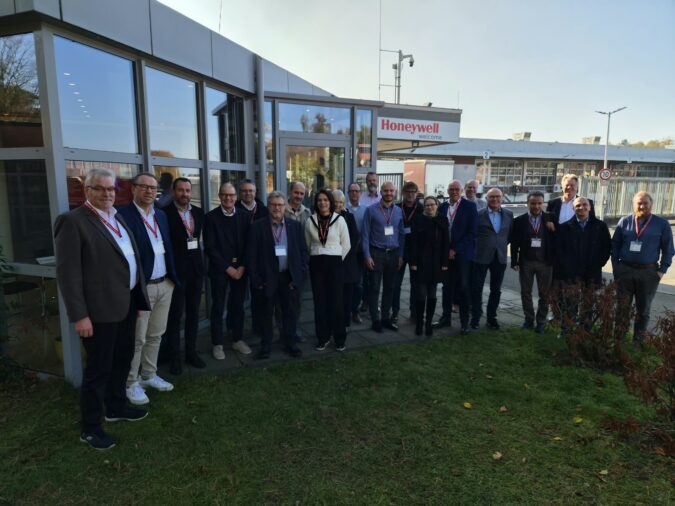
How can ceramic production facilities be converted to use new energy sources? What role can additive manufacturing play in the supply of spare parts? And which markets offer new opportunities for European technology suppliers? These questions were the focus of the meeting of the European Ceramic Technology Suppliers (ECTS) on 5 and 6 November in Lotte. The event was hosted by Honeywell Elster.
Representatives from European technology suppliers and institutions discussed current technical and economic developments in the ceramics industry. The focus was on the transformation of process heat, the modernisation of existing plants, additive manufacturing processes and the development of international markets.
New solutions for process heat
The transition of energy-intensive production processes is one of the key challenges facing the ceramics industry. Dr Tobias Schneider from Honeywell Elster presented hybrid heating systems and solutions that enable plants to switch from fossil fuels to hydrogen or electric heating. The choice of energy source alone is not the decisive factor here. Equally important is the question of how existing plants can be technically adapted and how new heating concepts can be integrated into existing production processes.
Additive manufacturing for spare parts supply
Additive manufacturing also offers new opportunities for machine and plant manufacturers. Dr Max Siebert from Replique demonstrated how 3D printing can be used, in particular, for the production of spare parts. This approach may be of interest to plant operators when components are no longer available or are required at short notice. The discussion therefore focused on the availability of spare parts and potential material savings.
Investments and plant modernisation
The economic framework conditions for the European machinery and plant engineering sector were also on the agenda. ECTS members discussed developments in international markets, as well as the impact of investment and energy prices on the ceramics industry. Another key focus was the modernisation of existing production facilities.
The discussion also looked beyond Europe. A delegation trip in May this year to Almaty in Kazakhstan, which included a symposium and visits to Talgar Brick Factory, Bosaga and Gornyi Kamen, proved very successful for the 11 participating companies. The network is considering a further delegation trip to Kyrgyzstan in 2027. Poland and possible participation from Ukraine are under discussion as alternatives.
Two new members join the network
ECTS has welcomed two new members: Aweld spol. s r.o. from the Czech Republic, and Vitreus GmbH from Germany. Aweld develops machinery and components for raw material processing. Vitreus specialises in engobes, glazes and surface treatments for heavy ceramics.
This expands the network’s technological scope, making it of interest not only to machinery manufacturers but also to suppliers. ECTS serves as a platform for European suppliers of technologies to the ceramics industry to discuss technical developments, exchange experiences and drive forward joint activities in international markets. This includes acting as the organising body for ceramitec, which takes place every two years in Munich; in 2028, the event will feature, amongst other things, an expanded Heavy Clay Experience.
ECTS stands for European Ceramic Technology Suppliers. It is a working group of European suppliers of machinery, materials and technical services for the manufacture of ceramics, powder metallurgy and related technologies. In this context, ceramics encompasses all types of raw materials as well as plant and machinery for the manufacture of refractory materials, bricks, tiles, sanitaryware, tableware and high-performance ceramics. ECTS connects and supports its members and fosters cooperation at all levels. ECTS is headquartered in Frankfurt am Main.